Articles · May 4, 2026
How to Actually Get a New Player Into Magic in 2026 (Without Scaring Them Off)
I once spent ten straight minutes trying to explain “Trample” to a friend. He was brand new to Magic and was still trying to figure out what “block” even meant. He nodded politely. His eyes glazed over somewhere around the third time I said “excess damage carries over.” At that point I knew I had completely lost him. That moment stuck with me. I love this game more than almost anything, but trying to share it with normal people has become borderline impossible.
Magic is still an incredible game. Yet the version we have in 2026 makes onboarding feel like teaching someone chess while they are also learning a new language and memorizing three hundred pages of rules. Most normies politely say “maybe next weekend” and never come back.
This is just one of my stories, and maybe you can relate if you have ever tried to bring a spouse, coworker, or friend into the hobby. What actually works?
Why the New Player Experience Is Broken Right Now
The game has been growing for thirty years, and that growth has piled up a lot of baggage. The official rules document went from roughly 199 pages in 2013 to 308 pages in 2026. Cards keep getting wordier. Keyword soup is everywhere. There are fifteen official card types now, plus new mechanics in every set.
Precons and “here, try my deck” attempts usually flop. The precons are either too simple to hold attention or, more often, way too complicated for someone who is still learning what an instant is. Handing a new player your tuned Commander deck and expecting them to figure it out is like giving a new driver the keys to a manual-transmission Ferrari and saying “just feel it out.”
I often hear that one of the best onboarding experiences for new players is Arena, the official app. While I agree it can be a great way to learn for people who are motivated, I don’t want to condemn my friend to two hours of solitary screen time just so they can eventually play a game with me.
The Four Things That Overwhelm New Players
I call them the New Player Taxes:
The “Brain Tax” (Rules Baggage)
New players get hit with a nonstop barrage of unfamiliar words and long blocks of text. Every card seems to have its own special keyword, and most of those keywords have no reminder text to explain them. On top of that there are now fifteen different card types, including things like Planeswalkers and Battles that never existed when the game started. Even if you hand them a simple starter deck, they still have to keep track of every single card played by every other person at the table. Their working memory fills up fast, and pretty soon they are spending more time feeling lost than actually playing.
The “Architect Tax” (Deckbuilding Complexity)
New players get handed a pre-built deck and are expected to know exactly what it is supposed to do. They have no idea why certain cards are in there or how the whole thing is supposed to work together. In cube or draft they are asked to build something from scratch with almost no context. Either way they feel like they are piloting someone else’s machine without the manual. The strategy stays hidden, the decisions feel random, and they quickly realize they are not really playing the game; they are just moving pieces around while the experienced players actually understand what is happening.
The "Time Tax" (Temporal Friction)
New players sit through long stretches where nothing exciting happens. Setup for draft or cube can eat up two hours before the first card is even played. In regular constructed games they watch everyone else spend the early turns just playing lands and doing nothing while the real action stays far in the future. With short attention spans already stretched thin by daily life, those slow starting turns feel endless. Many newcomers check out mentally long before the game ever gets interesting.
The "Mana Tax" (Resource Variance)
New players watch the table casually drop expensive dual lands while their own cards sit dead in hand. They draw too many lands and can not cast anything useful, or they draw too few and sit there with a handful of powerful spells they can not play. They quickly learn that the most expensive cards in the game are usually the ones that fix mana problems. It starts to feel like the real barrier to playing well is not skill or luck but how much money you have already spent on the right mana base.
These four taxes stack on top of each other until the new player checks out.
The Solution That Actually Works: BDE
Big Deck Encounter (BDE) is the same format I built to solve adult burnout, and it turns out it is also the best on-ramp for total beginners.
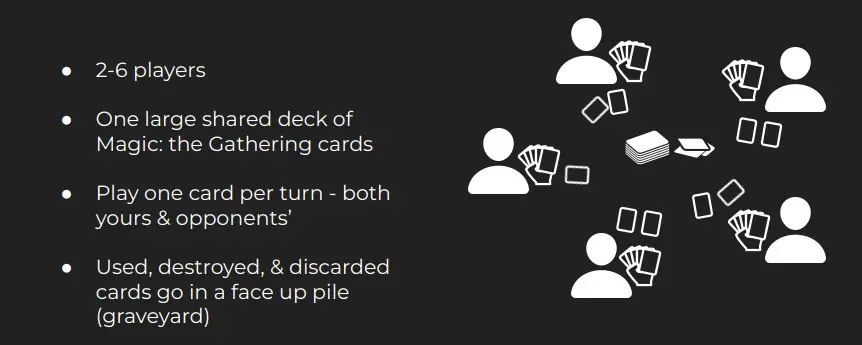
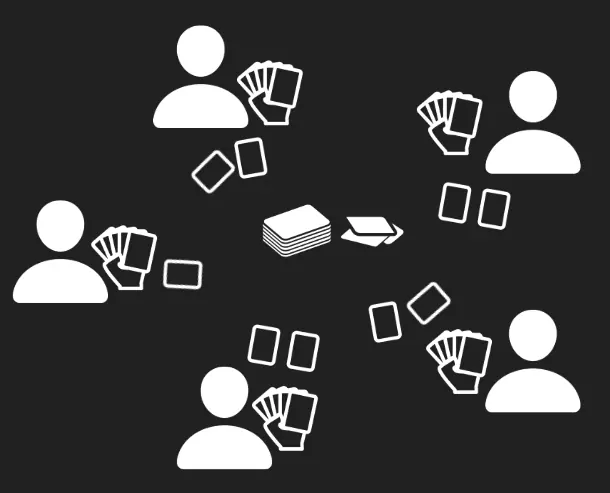
One shared 200-card Big Deck. Everyone draws from the exact same pile. Infinite mana for everyone. One spell per turn. No individual decks to build. No mana screw. Games start exploding on turn one and finish in 30 to 45 minutes.
The key to making BDE so friendly for new players is smart curation. Skip cards with complex mechanics or keywords that lack reminder text. Follow the 5-Line Rule and cut anything that looks like a wall of text. You would be surprised how much of a difference this makes for someone who is just starting out.
Some of you reading this might worry that I am suggesting a deck full of vanilla creatures. That was the old Portal and 7th Edition starter-deck approach decades ago. BDE is fast-paced and brutal. Make sure every creature has a reason to be in the deck: an enter-the-battlefield effect, a death trigger, or some other ability that actually matters.
The shared deck removes the “my deck versus your deck” intimidation. The simple rules mean you can teach the whole thing in under ten minutes. And because every game is chaotic and different, new players feel like they are actually playing Magic instead of studying for an exam.
How to Teach a Complete Beginner in Under 10 Minutes
Here is the script I use to teach new players. It actually works!
Big Picture
“The only goal is to get your opponent to zero life. You attack with creatures, they can block with theirs, and damage happens. You play cards from your hand to make it happen. That is it. Everything else is just details.”
Game Structure
“We are playing with one giant shared deck that everyone draws from. Everyone has infinite mana, so whenever a card has a cost you can always pay it. You only cast one spell during your own turn, but you can also play one instant card during each opponent’s turn. Used, destroyed, or discarded cards go into a face-up graveyard pile in the middle. Each player starts at 20 life and loses at zero.”
Playing a Turn
“On your turn you do these four things in order:
- Untap all your cards (turn them upright if they were tapped)
- Draw one card from the Big Deck
- Do combat and main phase in either order: attack with untapped creatures or play one card from your hand
- End your turn by discarding down to seven cards in your hand if you have more"
Card Examples
Pull out the following cards from the Big Deck as examples for the new player, showing where on the card that the card type is shown (in the middle).
- A Sorcery: “A powerful one-time effect that goes into the graveyard when it is done.”
- An Instant (a destroy spell): “Can be played at any time, including during other players’ turns, during combat, or in response to another player’s action.”
- A Counterspell: “This is a powerful instant that stops another card from being played.”
- A Creature: “This is a permanent that stays on the field until it is destroyed. Creatures are used to attack or block. They cannot attack or tap the turn they come into play.”
- An Artifact or Enchantment: “This is a permanent that does not attack or block but has powerful effects. Unlike creatures, these can be tapped the turn they come into play."
Combat
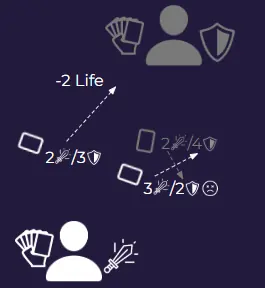
“Untapped creatures can attack or block. They cannot attack the turn they come into play. To attack, choose an opponent and tap the creature by turning it 90 degrees. The defending player decides if and how they want to block. Unblocked creatures deal damage to the defending player’s life total. Blocked creatures and blocking creatures deal damage to each other’s toughness. You can see a creature’s power (how much damage it deals) and toughness (how much damage it can take) in the bottom-right corner of the card.”
It is helpful to demonstrate combat by pulling some creatures out of the Big Deck and showing how it works.
The Stack
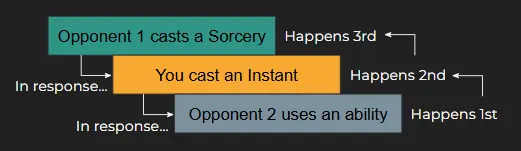
“Whenever anything happens, all players can respond with instants or abilities. Responses always happen in reverse order: the last thing played is the first thing that occurs.”
It is best to demonstrate this with cards in the Big Deck. I like to pull out any spell, a counterspell, and a permanent with an activated ability as an example to show this.
“We will help you with every rule as it comes up. Just ask questions whenever something feels confusing.”
Then we shuffle and start. We demonstrate instants and counterspells the first time they appear, and walk them through combat the first time someone attacks.
What Their First Game Actually Feels Like
You sit down, shuffle the one shared deck, draw seven cards. Everyone has infinite mana.
Player 1 starts with a Mage Hunter, ready to punish whatever the table tries to do. Player 2 answers by dropping a Blazing Archon, shutting down attacks. Player 3 decides the board needs to be cleared and tries to cast Inferno during Player 2’s turn, but Player 1 quickly counters it with a Hinder to protect the Mage Hunter. Player 4 surprises everyone by casting Murder on the Blazing Archon anyway; he already has a Zombify in hand ready to bring it back on his own turn. Player 3 then tries to slam down a Dusk Mangler on his turn, only for Player 2 to counter it with Cancel.
Every turn feels like the climax of a normal game. Exciting plays are happening right out of the gate and the new player is not sitting on the sidelines.
After the First Game: What Comes Next
BDE is not the end goal. It is the perfect on-ramp. Once they are hooked and having fun, you can gently introduce more of the full game: a JumpStart pack, a simple pre-con, or even a casual Commander game. The training wheels come off naturally because they already love the feeling of playing Magic.
One Important Caveat
BDE is not trying to replace the full Magic experience. Draft, Commander, Standard, and all the deep formats are still the heart and soul of the game. BDE is simply the friendly front door; the version that gets normies excited instead of terrified.
If you have ever wanted to share Magic with someone but were scared it would scare them off, this is the format that finally works. Build a Big Deck, invite a friend, and watch what happens.
The table is waiting.
Originally published on X.