Articles · August 22, 2026
So You’ve Decided to Build a Big Deck
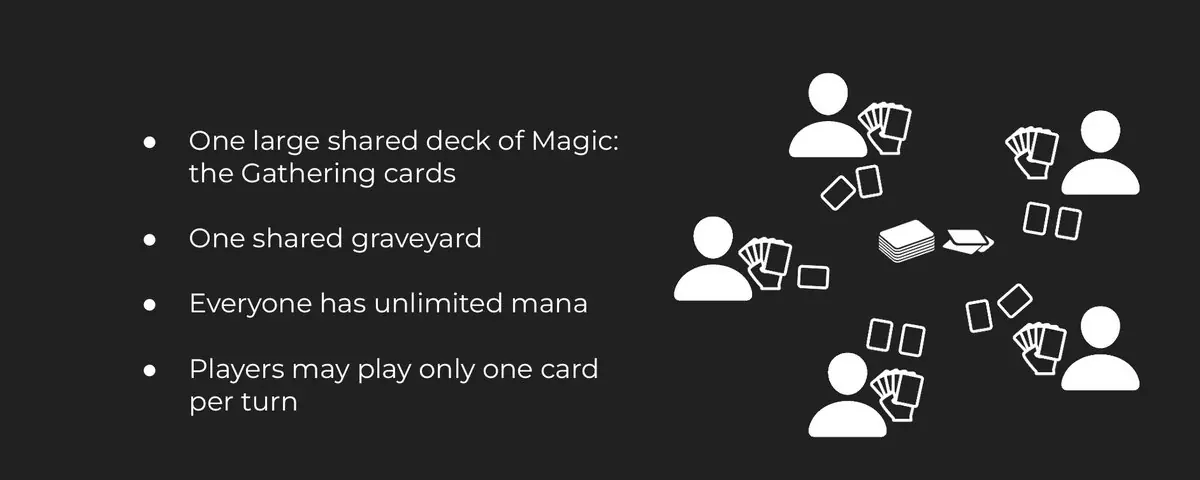
You just finished reading about Big Deck Encounter and something clicked. Infinite mana. One shared pile. Games that actually finish before the pizza gets cold. You’re already a solid Magic player. Maybe you’re coming back after a break. You’ve tuned Standard or Commander decks that actually function and drafted enough cubes to know what power level feels like. Maybe you’ve even tried Dandân. Or maybe you just want to get a new player involved without scaring them off. Now you’re staring at a mountain of cards (or a bulk bin) wondering how to turn that pile into a real Big Deck.
I’ve built dozens of them. I have made almost every mistake you can make along the way. Building the Big Deck is the single most important decision you will make in the format. Get it right and every game feels exciting and different. Get it wrong and the whole thing can start to feel repetitive or frustrating. The good news is that it is not nearly as hard as it looks once you understand the guiding principles.
You Are the Curator, Not the Optimizer
The biggest mindset shift is realizing you are not trying to build the most powerful deck possible. You are curating an experience for a mixed table of new players and veterans.
In every other format we play, the goal is consistency and power. Here the goal is different. A great Big Deck should deliver three things in every game:
• New players feel like they are actually playing Magic within the first few turns.
• Veterans still have real decisions and interesting plays.
• Every game feels different and chaotic in a good way.
Power level is secondary to fun and accessibility. If the deck is too weak, games drag. If it is too strong or too “solved,” people get bored or games resolve in a few turns. The sweet spot is consistent excitement with just enough swinginess to keep everyone engaged.
As the curator you also get to decide how the games feel. Want high-skill interactive Magic? Load the counterspells and removal. Want big stompy chaos where someone resolves a 10/10 and the table has to figure out how to answer it? Dial the interaction back. That control is one of the quiet pleasures of the format. You set the meta for the players.
The Four NOs
These rules are not suggestions. Break them and the format falls apart.
No Duplicates
Only one copy of each card. This keeps every draw fresh and prevents the deck from feeling solved or repetitive. Singleton is already familiar from Commander. Lean into it.
No Search
Tutors, fetch lands, “search your library” effects are all banned. No one wants to watch someone rifle through two hundred cards while everyone else waits. This includes keyword abilities like transmute. The shared deck is just too large and players don't know what's in it. Searching it breaks the game flow.
No X
Anything with an X in the cost or effect (Fireball & friends) is out. Infinite mana would let someone name an absurd number and end the game with zero interaction. The format dies the moment someone can just decide the game is over.
No Infinity
No infinite damage, life gain, life loss, draws, discards, power, toughness, or -X/-X. One big splashy turn is fun. Forty-five minutes of solitaire is not. The one-spell-per-turn rule already keeps things sane. Infinite loops break that.
Optional Quality-of-Life Rules
These are the rules I use when new players are at the table. You can ignore them for expert-only games if you want maximum chaos.
The 5-Line Rule: Cut any card with more than five lines of rules text. This prevents visual fatigue and working-memory overload. Just like Lexivore taught us.
Prevent Keyword Soup: Skip cards with complex keywords unless the reminder text is printed right on the card. Flying is usually fine. Most everything else is a tax on the new player.
Limit Permanent Types: Stick mostly to Creatures, Artifacts, Enchantments, Sorceries, and Instants. Planeswalkers, Battles, and other exotic types add extra rules baggage that is rarely worth it for casual nights. Basic lands and pure mana sources are useless here, so leave them out. Utility non-basic lands with interesting non-mana abilities are fair game and can create some memorable plays, so they can be considered.
Don’t Be Hasty: Creatures with haste are often too strong because they attack immediately. Use them sparingly.
Shared Graveyard Curation: Because everyone shares one graveyard, exclude Flashback and any abilities that activate from the graveyard (Eternalize, Hammer of Bogardan, and the like). “My graveyard is your graveyard” keeps the game moving; activated-from-graveyard effects fight that simplicity.
What Actually Belongs in the Deck
Target size: 150–250 cards. I usually aim for right around 200. (go as high as you want if you really love shuffling.)
Aim for a healthy mix. Official guidance sits around 25–50% creatures, 5–20% artifacts & enchantments, 10–25% sorceries, and 20–40% instants. I personally lean a bit heavier on creatures because the format rewards permanent presence and the table stays more interactive when people have things to attack and block with. Interaction density often skews high once you know what your group enjoys. Adjust to your table.
Prioritize cards that have a clear reason to exist:
• Enter-the-battlefield effects
• Strong activated or triggered abilities
• Value engines that reward actually playing the game
Skip vanilla creatures entirely. Since everyone has infinite mana, why spend your one spell per turn on a creature with no other effects? A 1/1 with an ability is almost always more useful than a vanilla 7/7 in the long run.
When it comes to complexity, watch for cards with alternate or reduced costing based on some condition. Mortality Spear is a very useful destroy spell, but the text “This spell costs {2} less to cast if you gained life this turn” will cause questions from a new player. Experienced players won’t bat an eye. Decide how much of that you want to explain.
Counterspells are a perfect example of a curation choice. Do you want every spell scrutinized with 25% counters in the deck, or do you want something more balanced around 5–10%? That single decision dramatically changes how the games feel.
BDE thrives on the fact that infinite mana unlocks cards that are not expensive. The $0.05 Cancel is functionally equivalent to the $70 Force of Will here. Include enough interaction and a couple of strong board wipes so games don’t stall out. They keep the table honest and give everyone a chance to come back. While the format thrives on cheap cards, there will always be a few expensive ones worth playing if you have them lying around. Platinum Emperion, Cool. Magus of the Moat? Absolutely. Keep an eye out for unique effects that shine when mana is not the bottleneck.
When the table is all veterans, I get much more permissive. Complicated game-state stress cards become part of the fun: Last Laugh, Abyssal Persecutor, Grip of Chaos, and some Un-set cards (Censorship, anyone?).
Variety is more important than tight synergy. You want the deck to feel different and surprising every game.
Step-by-Step Curation Process
1. Gather cards: Pull from your collection, buy cheap reprints, or use bulk. Focus on cards that are fun and impactful rather than expensive.
2. The Four NOs: Ruthlessly cut anything that violates the non-negotiable rules.
3. Quality-of-Life: Apply the optional rules if new players will be involved.
4. Balance: Make sure you have a good mix of creatures, removal, card advantage, and bombs. Check the overall feel.
5. Playtest and iterate: Play a few games. Take notes on what felt great and what felt boring or broken. Tweak between sessions. Most of my best Big Decks took three or four iterations to feel right.
Common Mistakes to Avoid
Filling the deck with too many boring creatures (the old Portal/7th Edition mistake). Again, a 1/1 with an ability is more useful than a vanilla 7/7.
Over-tuning for raw power instead of fun. Sometimes topdecking that Undying Beast is more entertaining than flipping over an Eldrazi bomb.
Ignoring the new-player experience (too many complex cards). Carefully consider how a new player will read and understand each selection.
Making the deck feel “solved” by including too many obvious best cards.
One more trap that veterans fall into: treating the Big Deck like a 200-card singleton high-power pile. The shared nature changes the math. Every card has to be interesting for multiple players across multiple games. A card that is “the best” in isolation can make the deck feel repetitive once everyone has seen it three times.
Final Thoughts
Your first Big Deck does not have to be perfect. The beauty of BDE is that it is easy to tweak. Just pull out a few cards and slide in new ones. Every time you play, you will learn what your group likes and what needs adjusting.
Build one this weekend. Take a picture of the pile when you are done. Tag me. I'd love to see and share it.
If sorting through bulk feels like a project for another weekend, I do have a few already built and ready to play. And more out in the wild for people to find.
The table is waiting.
Originally published on X.